Home › Financial advisors
Email signatures for financial advisors
Trust and compliance sit at the heart of financial services. A clean signature carries your credentials, firm branding and the disclosure line your emails need.
Why your email signature matters for financial advisors
Clients hand you their financial future — your emails should look the part. A signature with your credentials (CFP®, CFA and the like), firm branding, direct contact and a disclosure line projects credibility while keeping communications tidy.
What to put in a financial advisor email signature
Name & credentials
Display designations such as CFP®, CFA or ChFC after your name.
Firm name & logo
Consistent branding for your practice or broker-dealer.
Direct contact details
Phone, office and website so clients can reach you easily.
Disclosure / disclaimer line
Add the regulatory disclosure or confidentiality text your firm requires.
Booking button
A call-to-action linking to a review-meeting scheduler.
Firm-wide consistency
Deploy one locked template so every advisor's signature matches and stays compliant.
Build yours in minutes
- Open the generator and enter your work email — your logo, colors and social links are imported from your website automatically.
- Pick a template and fill in your name, title and the details that matter for your role.
- Add a call-to-action button — the one action you most want recipients to take.
- Install it into Gmail or Outlook in one click, or roll it out to your whole team.
What belongs in this signature, line by line
The fields below are the ones this profession is actually judged on — by clients, by referral sources and in some cases by a regulator.
Name + credential and registration
CFP, CFA, ChFC, and your registration status — IAR, registered representative, or both. These are the identifiers clients and regulators look for.
Firm name and the RIA or broker-dealer relationship
If you are affiliated with a broker-dealer, its name and FINRA/SIPC membership are typically required alongside yours.
CRD/IARD number where your firm requires it
Many compliance departments mandate it in client-facing correspondence.
What you actually advise on
“Retirement planning for physicians” routes enquiries far better than “Financial Advisor”.
Direct line — advice is a relationship business
Clients call about markets, not forms.
Required disclosures, exactly as compliance approved them
This is the one profession where you should not write your own signature text.
The most compliance-bound signature in this entire category
Financial advice sits under overlapping regimes — securities regulators, FINRA rules for broker-dealer-affiliated representatives, investment-adviser rules for RIAs and IARs, and each firm's own compliance manual, which is usually stricter than any of them. Several consequences follow that do not apply anywhere else on this site. Advisor email is generally treated as a communication with the public, which means it may be subject to supervision, review and record-retention requirements — your signature is archived along with everything else. Firms commonly mandate specific disclosure language, prohibit performance claims or testimonials outright, and require the broker-dealer's name and membership marks to appear. The correct posture is therefore unusual: do not compose your own signature. Get the block approved by compliance and deploy that exact version. Rules vary by regime, registration type and firm, and they change — confirm yours; general framing is in legal requirements.
Why advisory firms adopt central deployment first
Because so much of the block is mandated and supervised, financial services is consistently among the earliest industries to standardise signatures centrally — and for a concrete reason: if a disclosure requirement changes, a firm with forty advisors editing their own Gmail signatures has forty opportunities to get it wrong and no way to prove they did not. One locked, compliance-approved design with each advisor's own name, credentials and CRD filled in solves both the accuracy problem and the audit problem in one move, and it updates everywhere at once. That is exactly the mechanism described in team deployment. Adjacent regulated trades face the same pattern — see the insurance and mortgage guides.
Mistakes that show up most in this field
Writing your own disclosure language
Compliance approves signature text in this profession. Improvising is the error.
Any performance claim or client testimonial
Commonly prohibited outright, and a signature is a communication with the public.
Omitting the broker-dealer name or membership marks
Frequently required for affiliated representatives.
A marketing banner nobody reviewed
In a supervised, archived channel, an unreviewed promotional line is a real risk.
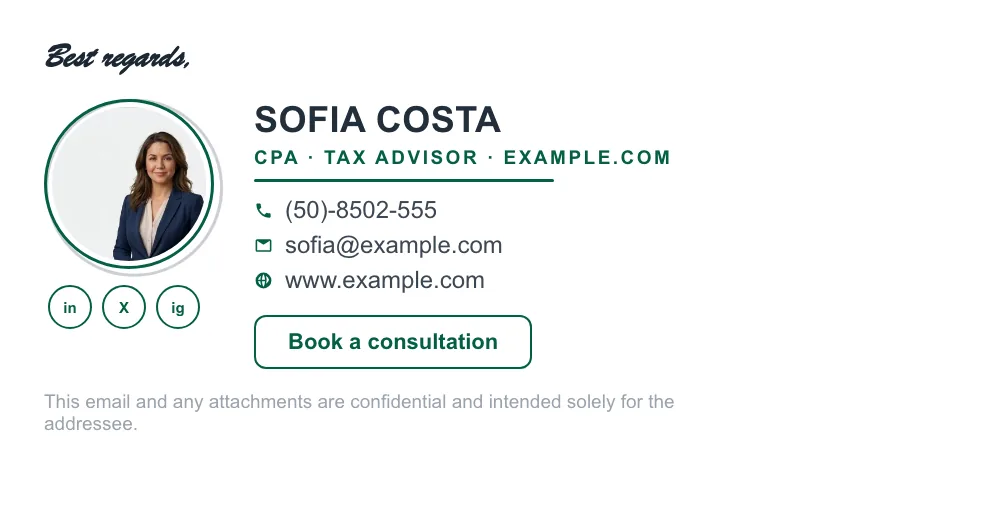
Three layouts that work for this profession
Real renders, not mockups — this is the output that reaches an inbox. Under each is why that layout suits this kind of work.


Written and maintained by the ProSignature team. Competitor pricing and feature claims on this site are verified against each vendor's live page on the day of writing — last verified 26 July 2026. No affiliate links. How we work.
Look trustworthy and stay compliant
Design it in minutes and install it in one click.
Create my signature — freeFrequently asked questions
What should a financial advisor's email signature include?
Your name with professional designations (CFP®, CFA, etc.), your firm's name and logo, direct contact details, and any regulatory disclosure or disclaimer line your firm or broker-dealer requires.
Can I add a required compliance disclosure?
Yes. ProSignature has an editable disclaimer field for the disclosure text your firm mandates, so it appears consistently on every email. Always have your compliance team approve the wording.
Can our whole practice use one approved signature?
Yes. Design a master signature with the approved disclosure, lock it, and roll it out to every advisor so branding and compliance stay consistent.
Are financial advisor emails subject to compliance review?
Generally yes — advisor email is typically treated as a communication with the public and may be subject to supervision and record-retention requirements, signature included. Confirm your obligations with your compliance department.
Can a financial advisor put testimonials in an email signature?
Testimonials and performance claims are commonly restricted or prohibited in this profession. Never add them without explicit compliance approval.