Home › Doctors & clinics
Email signatures for doctors and clinics
Medical email carries confidential patient information, so a physician's signature is governed more by confidentiality and scope than by design.
Why your email signature matters for doctors
A physician's email signature is shaped almost entirely by two constraints rather than by branding. The first is confidential patient information: ordinary patient correspondence can contain it, standard email is not a secure channel, and most practices therefore include a short notice stating that the message is confidential, intended only for the named recipient, and that email must not be used for urgent clinical concerns — usually with a line directing emergencies to the practice phone or emergency services. Patient-privacy law applies wherever you practise. Nothing patient-identifying should ever appear in an auto-appended block.
The second is identification: credentials, specialty and the practice a physician is writing on behalf of, because the same signature is read by patients, referring colleagues, insurers and sometimes regulators, each of whom needs to place you. Where a practice has many clinicians, deploying one design with each physician's own credentials filled in is both easier and safer than each person composing their own — see team deployment. Requirements vary by jurisdiction and by your institution's compliance policy; confirm rather than copying. Related: healthcare and dentists.
What to put in a doctor email signature
Name + credentials
MD, DO, MBBS, plus board certification and any fellowship — patients and referrers both read these first.
Specialty and sub-specialty
The routing information every referring clinician needs.
Practice or institution name
Whose behalf you are writing on, which matters for both patients and insurers.
Practice phone — never a personal line
Keeps clinical contact inside the practice's systems and records.
A confidentiality notice
Short: intended recipient only, email is not secure, not for urgent clinical matters, with an emergency route.
A patient-portal link, where you have one
Redirects clinical questions to the channel built for them.
New-patient or referral status
Saves both patients and referrers a wasted enquiry.
Nothing patient-identifying
No chart numbers, appointment references or case details in a template.
Build yours in minutes
- Open the generator and enter your work email — your logo, colors and social links are imported from your website automatically.
- Pick a template and fill in your name, title and the details that matter for your role.
- Add a call-to-action button — the one action you most want recipients to take.
- Install it into Gmail or Outlook in one click, or roll it out to your whole team.
Three layouts that work for this profession
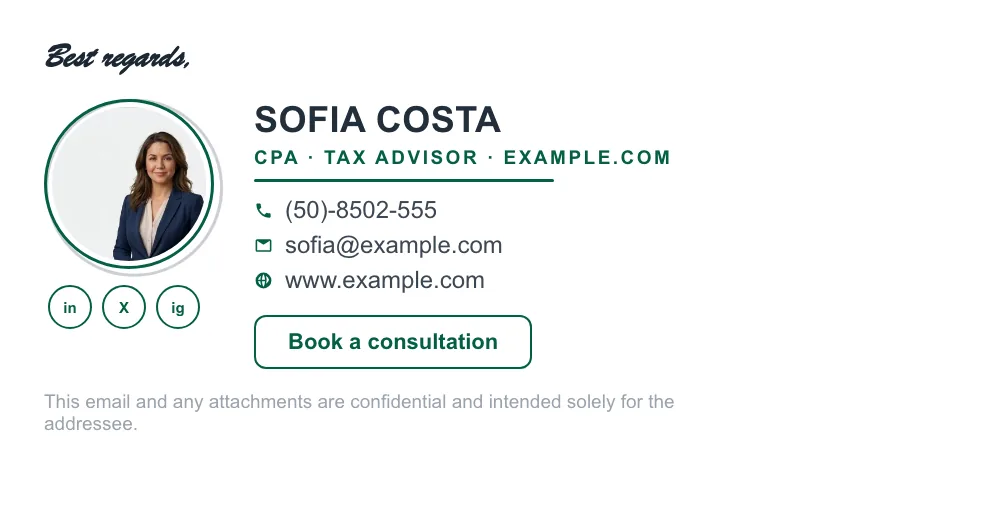
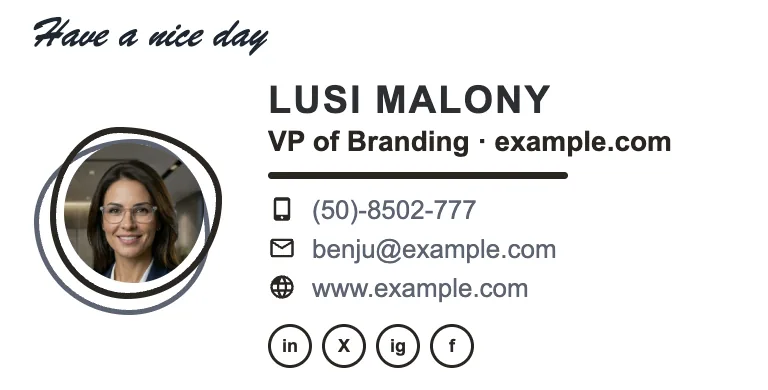
Real renders, not mockups — this is the output that reaches an inbox. Under each is why that layout suits this kind of work.

Written and maintained by the ProSignature team. Competitor pricing and feature claims on this site are verified against each vendor's live page on the day of writing — last verified 26 July 2026. No affiliate links. How we work.
Build a practice signature in minutes
Design it in minutes and install it in one click.
Create my signature — freeFrequently asked questions
What should a doctor's email signature include?
Name with credentials and board certification, specialty, practice or institution, the practice phone, a short confidentiality notice with an emergency route, a patient-portal link where available, and referral or new-patient status.
Do doctors need a confidentiality notice in email?
Patient correspondence can contain confidential patient information and standard email is not secure, so a short confidentiality notice directing urgent matters elsewhere is standard practice. Confirm specifics with your institution's compliance policy.
Can a clinic use one email signature for all its doctors?
Yes, and it is safer: one design deployed with each clinician's own credentials and specialty filled in keeps the required elements consistent and updates in one place when policy changes.