Home › Architects
Email signatures for architects & design studios
Your email goes to clients, contractors and planning boards. A signature with studio-grade restraint — wordmark, license, portfolio — carries your design standard into every thread.
Why your email signature matters for architects
Architecture clients judge visual judgment. A cluttered signature undercuts a portfolio full of restraint; a precise one — studio wordmark, AIA/license credential, one portfolio link — extends it. ProSignature pulls your exact brand colors from your site so the signature matches the letterhead, and locks the design across the studio.
What to put in an architect email signature
Studio wordmark
Your logo at the right size, hosted properly — auto-extracted from your site.
License / AIA credential
The professional stamp, styled discreetly.
Portfolio link CTA
'View selected work' — the one click that sells.
Project-role clarity
Principal, project architect, site lead — so contractors know who decides.
Build yours in minutes
- Open the generator and enter your work email — your logo, colors and social links are imported from your website automatically.
- Pick a template and fill in your name, title and the details that matter for your role.
- Add a call-to-action button — the one action you most want recipients to take.
- Install it into Gmail or Outlook in one click, or roll it out to your whole team.
What belongs in this signature, line by line
The fields below are the ones this profession is actually judged on — by clients, by referral sources and in some cases by a regulator.
Name + registration and jurisdiction
“RIBA”, “AIA”, “Registered Architect (NY)”. In most jurisdictions the title “architect” is legally protected and tied to registration.
Practice name and, where required, registration number
Many boards require the practice's registration to appear on professional correspondence.
Sector focus
Residential, commercial, heritage, healthcare — a practical routing filter for enquiries and consultant referrals.
Portfolio or projects link
Architecture is bought visually, like design and photography.
Direct line for project correspondence
Construction moves on the phone during delivery phases.
Professional-indemnity note if your practice requires it
Some practices append a standard limitation line to project correspondence.
A protected title, and correspondence that becomes a record
Two things shape an architect's signature. The first is that in most jurisdictions “architect” is a protected title — using it without registration is a regulatory matter, and correspondingly your registration and jurisdiction are the credibility anchor of the block. The second, and less obvious, is that architectural email frequently becomes part of a project record: instructions, approvals and clarifications sent by email are routinely relied on and sometimes produced in disputes years later. That argues for a restrained, unambiguous signature carrying registration, practice identity and role — and against anything that muddies who was writing in what capacity. Many practices also append a short line clarifying that email correspondence does not constitute a formal instruction or variation. Requirements vary by board and jurisdiction; confirm yours, and see legal requirements for the general framing.
Restraint as a professional signal
Architects share designers' problem of being judged on visual craft, and the same constraint applies: email clients strip web fonts and block images, so an elaborate signature will not render as intended and a signature exported as an image will render as an empty box with an unclickable phone number. The version that reads as most competent is precise and plain — accurate alignment, a restrained type hierarchy, one accent colour, generous spacing, and a link to the projects rather than an attempt to show them inline. Technical rules are in best fonts and image sizes; the case against image-based signatures is in the Canva comparison.
Mistakes that show up most in this field
Using the title without stating registration
The title is protected in most jurisdictions; registration is the point.
An image-based signature
Unclickable contact details on correspondence that becomes a project record.
Renderings embedded in the signature
They arrive compressed and blocked. Link to the portfolio.
Ambiguity about the capacity you are writing in
Project email is relied on later; the role line should be unambiguous.
Three layouts that work for this profession
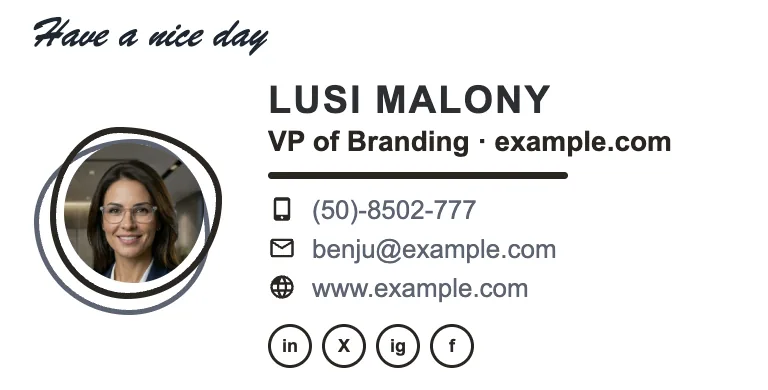
Real renders, not mockups — this is the output that reaches an inbox. Under each is why that layout suits this kind of work.


Written and maintained by the ProSignature team. Competitor pricing and feature claims on this site are verified against each vendor's live page on the day of writing — last verified 26 July 2026. No affiliate links. How we work.
Design discipline, down to the signature
Design it in minutes and install it in one click.
Create my signature — freeFrequently asked questions
Minimal or detailed for architecture?
Minimal. Wordmark, name, credential, one portfolio link. Whitespace is the brand.
Can I show a project photo?
A thin banner with a signature project works well during awards season or launches — swappable anytime.
Same design across the studio?
Yes — Teams locks typography and layout; each architect gets their own role and direct line.
What should an architect's email signature include?
Name with registration and jurisdiction, practice name and registration number where required, sector focus, a projects or portfolio link, a direct line, and any limitation wording your practice appends to project correspondence.
Is 'architect' a protected title in email signatures?
In most jurisdictions the title is legally protected and tied to registration, so it should be used only by registered architects and is normally accompanied by the registration and jurisdiction. Confirm with your board.
Should architects put renderings in their email signature?
No — images are blocked by default in many clients and arrive compressed. Link to the portfolio where the work is presented properly.