Home › Insurance agents
Email signatures for insurance agents
Policies are bought from people, not carriers. A signature with your face, license and a “Get a quote” button turns routine replies into renewals and referrals.
Why your email signature matters for insurance agents
Insurance runs on long relationships and quick answers. When your reply carries a professional photo, your NPN/license number and one-tap phone and quote links, clients forward it with confidence — and prospects see an agent, not a call center. Compliance teams like that the disclaimer ships automatically on every message.
What to put in an insurance agent email signature
License / NPN number
Many states expect it in client correspondence — make it automatic.
Personal photo
People insure with people they recognize — especially at renewal time.
“Get a quote” CTA
A one-tap button that turns replies into new business.
Compliance disclaimer
Standard E&O-friendly wording, attached to every email.
Build yours in minutes
- Open the generator and enter your work email — your logo, colors and social links are imported from your website automatically.
- Pick a template and fill in your name, title and the details that matter for your role.
- Add a call-to-action button — the one action you most want recipients to take.
- Install it into Gmail or Outlook in one click, or roll it out to your whole team.
What belongs in this signature, line by line
The fields below are the ones this profession is actually judged on — by clients, by referral sources and in some cases by a regulator.
Name + licence number and state(s)
Insurance producers are licensed per state and per line of authority; most jurisdictions treat agent email as advertising, so the producer number generally belongs in it.
Agency name and, where applicable, the carrier relationship
Captive agents usually must identify the carrier; independent brokers benefit from saying they are independent, since it is the whole value proposition.
Lines of business you actually write
“Commercial property & liability” or “Medicare & life”. It routes enquiries and avoids licensing mismatches.
Direct line — insurance is still a phone business
Claims and renewals move by voice; make the number prominent.
A quote CTA, not a generic website link
“Get a quote in 24 hours” is the transaction the recipient wants.
Required regulatory or compliance lines
Varies widely by state, line and carrier — confirm against your carrier's advertising-review rules.
Compliance is set by two masters, not one
Insurance is unusual in that an agent's email signature is governed both by state regulation and, separately, by the carrier's own advertising review. State insurance departments generally treat producer email as advertising, which is why the licence number and agency identification commonly appear. On top of that, appointed and captive agents are typically bound by carrier rules on logo usage, approved product language and required disclosures — and those rules are frequently stricter than the regulator's. The practical consequence is that agents should not freestyle: the signature should be assembled from what the carrier has approved, and an agency with multiple producers is far safer deploying one reviewed design centrally than trusting each agent to reconstruct it. Requirements differ by state, line of authority and carrier, so confirm yours rather than copying another agent's block; general framing is in legal requirements and central rollout is covered in team deployment.
Renewals are the signature's real job
Most insurance signature advice focuses on new business, but the higher-value use is retention. Agents email existing policyholders constantly — endorsements, renewals, claims updates — and each of those emails is a chance to prompt the review conversation that prevents a shopper from leaving. A rotating line does this well: “Annual policy review — book 15 minutes” during renewal season, or a cross-sell prompt (“Ask me about umbrella coverage”) the rest of the year. Because the audience already trusts you, these convert far better than cold acquisition CTAs. Wording patterns are in the CTA examples.
Mistakes that show up most in this field
Omitting the producer licence number
The most common compliance gap, and the easiest to close.
Using carrier logos without checking usage rules
Carrier brand guidelines are usually stricter than agents assume.
“Insurance agent” with no lines of business
Generates enquiries for products you may not even be licensed to write.
No quote or review CTA
The two transactions this profession runs on, routinely missing.
Three layouts that work for this profession
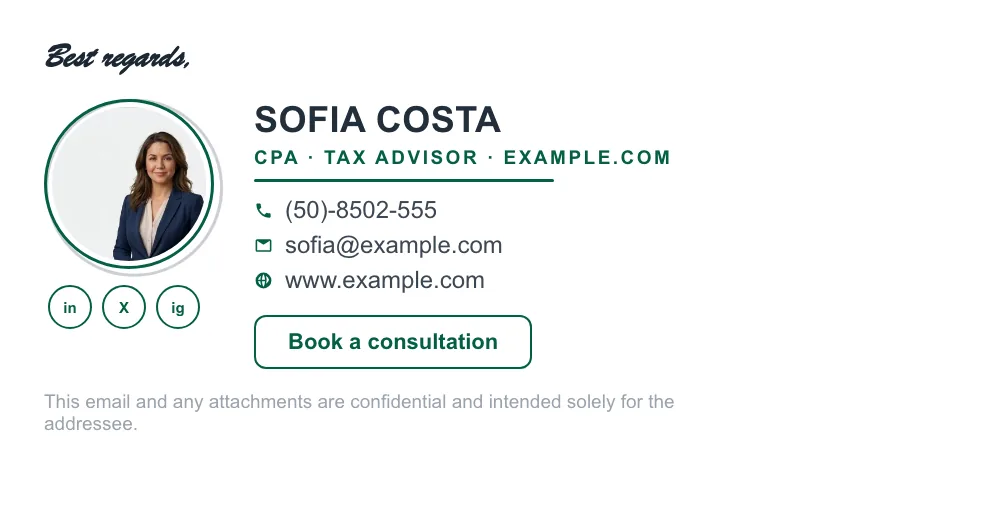
Real renders, not mockups — this is the output that reaches an inbox. Under each is why that layout suits this kind of work.


Written and maintained by the ProSignature team. Competitor pricing and feature claims on this site are verified against each vendor's live page on the day of writing — last verified 26 July 2026. No affiliate links. How we work.
Every email is a soft renewal reminder
Design it in minutes and install it in one click.
Create my signature — freeFrequently asked questions
Do I need my license number in my signature?
Rules vary by state and line, but including your license/NPN is common practice and often required in marketing correspondence — safest to include it.
Can each producer have their own details?
Yes — Teams deploys one locked design and fills in each producer's name, license and phone automatically.
Can I show carriers I represent?
Keep the signature clean — link “See our carriers” to your website instead of stacking logos.
What should an insurance agent's email signature include?
Name with producer licence number and state, agency name and carrier relationship where required, the lines of business you write, a direct phone number, and a quote or policy-review call-to-action. Confirm specifics with your state and carrier.
Do insurance agents need a licence number in their email signature?
Most states treat producer email as advertising, so the licence number and agency identification are commonly required. Requirements vary by state and line of authority — check with your department of insurance and your carrier.
What is the best call-to-action for an insurance agent?
For existing policyholders, an annual policy review booking — retention converts far better than cold acquisition. For prospects, a time-bound quote offer.