Home › Healthcare professionals
Email signatures for healthcare professionals
In healthcare, clarity and confidentiality matter. A clean signature carries your credentials, practice details and a privacy notice on every email.
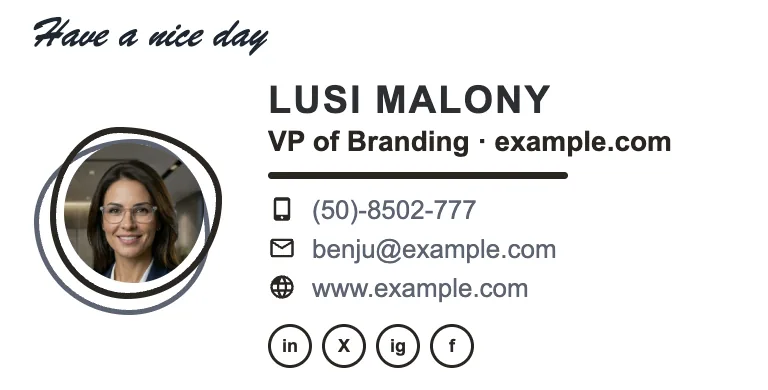
Why your email signature matters for healthcare professionals
Patients and colleagues need to know exactly who they're dealing with. A signature with your name and credentials, role, practice or clinic, contact details and an appropriate confidentiality notice keeps your communications professional and clear.
What to put in a healthcare professional email signature
Name & credentials
Your name with MD, RN, DDS, PhD or the credentials relevant to your role.
Role & department
Your title and the practice, clinic or department you work in.
Practice contact details
Clinic phone, address and website so patients can reach the right place.
Confidentiality notice
An editable privacy/confidentiality line appropriate to patient communications.
Appointment or portal link
A button linking to appointment booking or your patient portal.
Consistent clinic branding
Roll one template out so the whole practice looks unified.
Build yours in minutes
- Open the generator and enter your work email — your logo, colors and social links are imported from your website automatically.
- Pick a template and fill in your name, title and the details that matter for your role.
- Add a call-to-action button — the one action you most want recipients to take.
- Install it into Gmail or Outlook in one click, or roll it out to your whole team.
The constraint that shapes every healthcare signature
Healthcare correspondence can contain confidential patient information, and ordinary email is not a secure channel. That single fact determines more about a clinical signature than any branding consideration. Most organisations therefore append a short confidentiality notice: that the message is intended only for the named recipient, that email should not be used for urgent clinical concerns, and where to go instead — usually the practice phone or emergency services. Patient-privacy law applies wherever you practise. The corollary is absolute: nothing patient-identifying belongs in an auto-appended block — no chart numbers, no appointment references, no case details, because a template applies to every message regardless of recipient.
One signature, four audiences
Patients
Need warmth, the practice contact, booking, and a clear statement of what email is not for.
Referring clinicians
Need credentials, specialty and a direct professional route. A consumer booking widget reads oddly on a referral letter.
Insurers and administrators
Need the institution named and the clinician identifiable.
Regulators, occasionally
Which is the argument for accuracy over marketing throughout — a signature is a record.
The practical resolution
Lead with credentials and institution, keep patient-facing elements secondary, and keep promotional content off clinical correspondence entirely.
Multi-clinician practices
Deploy one design with each clinician's own credentials filled in, so required elements stay consistent and update in one place — team deployment.
Related guides by discipline
The specifics differ by profession: doctors and clinics, dentists, therapists and counsellors, chiropractors, nutritionists and dietitians and veterinary practices each carry different credentials, scope statements and emergency-routing requirements. Requirements vary by jurisdiction and by your institution's compliance policy — confirm rather than copying; the general framing is in legal requirements.
Three layouts that work for this profession
Real renders, not mockups — this is the output that reaches an inbox. Under each is why that layout suits this kind of work.
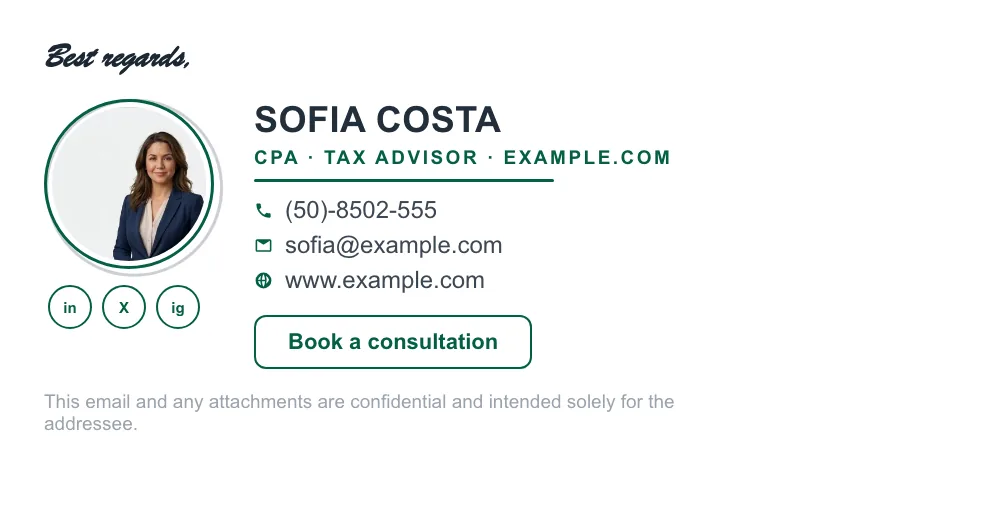

Written and maintained by the ProSignature team. Competitor pricing and feature claims on this site are verified against each vendor's live page on the day of writing — last verified 26 July 2026. No affiliate links. How we work.
Professional and clear on every message
Design it in minutes and install it in one click.
Create my signature — freeFrequently asked questions
What should a healthcare professional's email signature include?
Your name and credentials, your role and department, the practice or clinic name, contact details, and a confidentiality notice appropriate to healthcare communications. Avoid including any patient information.
Can I add a confidentiality notice?
Yes. ProSignature includes an editable disclaimer field for a confidentiality or privacy notice. For regulated communications, confirm the wording with your organization's compliance team.
Can our clinic standardize everyone's signature?
Yes. Design one clinic template, lock the branding and disclaimer, and deploy it to every provider and staff member.