Home › Fitness trainers
Email signatures for personal trainers and fitness coaches
Clients book sessions from replies, not brochures. Put a booking button, your certifications, and your Instagram under every email you send, so the next "how much do you charge?" message turns into a scheduled session.

Why your email signature matters for fitness trainers
Most of your bookings don't start on your website; they start in a reply. A prospect emails about rates, you answer, and whatever sits under your name either moves them toward a session or does nothing. A trainer's signature should carry a "Book a session" button so nobody has to ask for your calendar link, your NASM or ACE credentials right where a hesitant beginner can see them, and your Instagram, because clients always check your feed before they commit. It also keeps you consistent: the follow-up you send at 9 p.m. from your phone looks as put-together as your welcome packet. Browse real signature CTA examples to steal what converts, then compare layouts in our examples gallery.
What to put in a fitness trainer email signature
Booking CTA button
A tap-ready "Book a session" button linking to your Calendly, Mindbody, or Trainerize scheduler, so prospects never have to ask how to get on your calendar.
NASM, ACE, or CSCS credentials
Your certifications listed right after your name, because beginners comparing trainers who all promise results trust the one with visible proof.
Instagram profile link
A social icon that sends leads straight to your training clips and client results, since almost everyone checks your feed before they commit to a session.
Client transformation banner
A slim before-and-after or client-review strip under your details, built with the AI Banner Maker, that does the trust work in every reply.
Build yours in minutes
- Open the generator and enter your work email — your logo, colors and social links are imported from your website automatically.
- Pick a template and fill in your name, title and the details that matter for your role.
- Add a call-to-action button — the one action you most want recipients to take.
- Install it into Gmail or Outlook in one click, or roll it out to your whole team.
What belongs in this signature, line by line
The fields below are the ones this profession is actually judged on — by clients, by referral sources and in some cases by a regulator.
Name + certification
NASM, ACE, ACSM, NSCA or your national equivalent. Fitness is largely unregulated, so certification is one of the few external trust signals.
Specialism
Strength, pre/post-natal, rehabilitation-adjacent, endurance, senior fitness. It is how clients self-select.
Where you train clients
Gym name, studio, in-home, or online — the first practical question every enquiry has.
Booking or trial-session link
Fitness converts on a first session, not on information.
Instagram, if you use it professionally
For most trainers it functions as the portfolio and the social proof.
A scope note where relevant
Trainers are not clinicians; a short line keeps that boundary clear where clients may assume otherwise.
Certification and scope in an unregulated field
Personal training has no universal licensing regime, which means anyone may use the title and prospective clients cannot easily distinguish a four-year specialist from a weekend certificate. Two signature elements do most of the trust work: a recognised certification named specifically, and a specialism narrow enough to imply real experience. The second consideration is scope. Trainers routinely receive questions that edge into clinical territory — injuries, pain, medication, pregnancy complications — and a brief line clarifying that you provide fitness coaching rather than medical advice, and that clients should consult their physician, is both honest and protective. Avoid any language in the signature that implies treatment, diagnosis or guaranteed outcomes; results claims are the most common overreach in this field.
The signature as a booking engine
Almost nobody hires a trainer from reading about one. They book a first session, and the session sells the rest. So the entire job of a trainer's call-to-action is to make that first session as easy and low-risk as possible: “Book a free intro session” or “First session £25” outperforms “Get in touch” by a wide margin because it names the commitment. If you run programmes or small-group cohorts, add the start date — true urgency again. And if you also sell online coaching, keep it as a secondary line rather than a competing CTA. Patterns are in the CTA examples, and the layout trainers use is in the examples gallery.
Mistakes that show up most in this field
No certification named
In an unregulated field it is one of the few verifiable signals you have.
Clinical language
“Rehab”, “treatment” and “healing” blur a boundary worth keeping clear.
Guaranteed-results claims
The most common overreach in fitness marketing, and the least defensible.
“Personal trainer” with no specialism or location
Clients self-select on both.
Three layouts that work for this profession
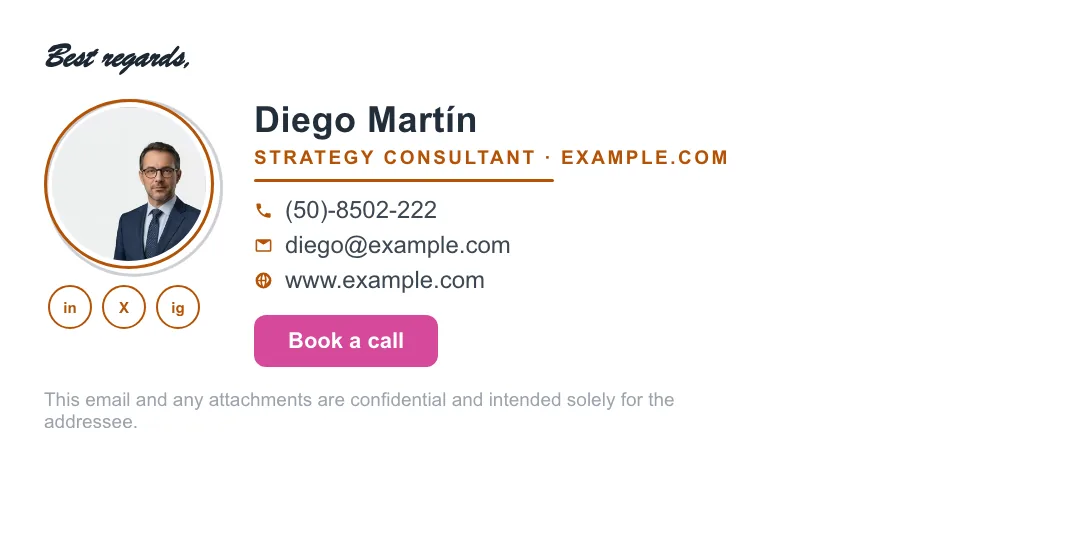
Real renders, not mockups — this is the output that reaches an inbox. Under each is why that layout suits this kind of work.

Written and maintained by the ProSignature team. Competitor pricing and feature claims on this site are verified against each vendor's live page on the day of writing — last verified 26 July 2026. No affiliate links. How we work.
Your next client is already in your inbox
Design it in minutes and install it in one click.
Create my signature — freeFrequently asked questions
Can I put my booking link in my email signature?
Yes, and you should. Add a button labeled "Book a free consult" or "Schedule a session" that points to your Calendly, Mindbody, or Trainerize page, then check it in ProSignature's live Gmail-style preview to make sure it reads clearly on a phone-sized screen before you install.
How do I show my NASM or ACE certification in my signature?
Put the credential right after your name, for example "Jordan Reyes, NASM-CPT," with a title line like "Certified Personal Trainer" underneath. Stick to your top one or two certs so the line stays scannable instead of reading like alphabet soup.
Should I link my Instagram in my trainer signature?
For most trainers, yes: Instagram converts better than a website because it shows client results and your coaching style in motion. Enter your domain and ProSignature pulls your social profiles automatically, or add your handle manually in the editor.
What should a personal trainer's email signature include?
Name with a recognised certification (NASM, ACE, ACSM, NSCA), a specialism, where you train clients, a booking or trial-session link, and a professional social profile — plus a short scope note where clients might assume clinical expertise.
How do personal trainers build trust in an email signature?
By naming a recognised certification and a narrow specialism. Fitness is largely unregulated, so verifiable credentials and specificity do the work that licensing does in other professions.
What call-to-action works best for personal trainers?
A free or low-cost first session. Clients buy after training with you once, so the CTA should minimise the commitment needed to get there.