Home › Massage therapists
Email signatures for massage therapists
Most enquiries arrive from someone in discomfort who is comparing two or three therapists. Licence, modality and a booking link answer their whole question before they have to ask it.
Why your email signature matters for massage therapists
Massage therapy sits in an awkward regulatory space that shapes the signature more than most therapists expect. In many US states and Canadian provinces the title is licensed or registered (LMT, RMT, LMBT) and the licence number is expected in professional advertising; in other jurisdictions the field is certified rather than licensed, and the distinction matters to clients who are checking. Whichever applies to you, name the exact credential you hold and the state or province it is held in — vagueness reads as evasion in a field where clients are being asked to undress.
The second constraint is scope. Massage therapists routinely receive questions that shade toward medical territory — injuries, chronic pain, post-surgical work, pregnancy — and both regulators and insurers care how that is described. Avoid language implying diagnosis, treatment or cure; describe modalities and what a session involves instead. A short line noting that massage complements rather than replaces medical care is common practice and protects both sides. Rules vary by jurisdiction and by any association you belong to, so confirm yours rather than copying another therapist's wording; the general framing is in legal requirements, and the adjacent field is covered in therapists and counsellors.
What to put in a massage therapist email signature
Name + exact credential and jurisdiction
LMT, RMT, LMBT or your equivalent, with the state or province. Clients in this field genuinely check.
Modalities you actually practise
Deep tissue, sports, prenatal, lymphatic, myofascial. This is how clients self-select and how referrals are made — two or three, not a list of eight.
Where you work
Studio, clinic, mobile or in-home. The first practical question every enquiry has, and a hard filter.
Online booking link
The highest-converting element for this trade. Enquiries often arrive in the evening; a booking link captures them, a phone number does not.
A scope note
That massage complements rather than replaces medical care, and that you do not diagnose. Standard practice and protective.
Insurance or association membership
Where clients or insurers expect it — one line, named specifically.
Cancellation policy link, if late cancellations hurt you
A quiet link does the awkward work without a conversation.
No before-and-after or outcome claims
The most common overreach in this field and the least defensible with a regulator.
Build yours in minutes
- Open the generator and enter your work email — your logo, colors and social links are imported from your website automatically.
- Pick a template and fill in your name, title and the details that matter for your role.
- Add a call-to-action button — the one action you most want recipients to take.
- Install it into Gmail or Outlook in one click, or roll it out to your whole team.
Three layouts that work for this profession
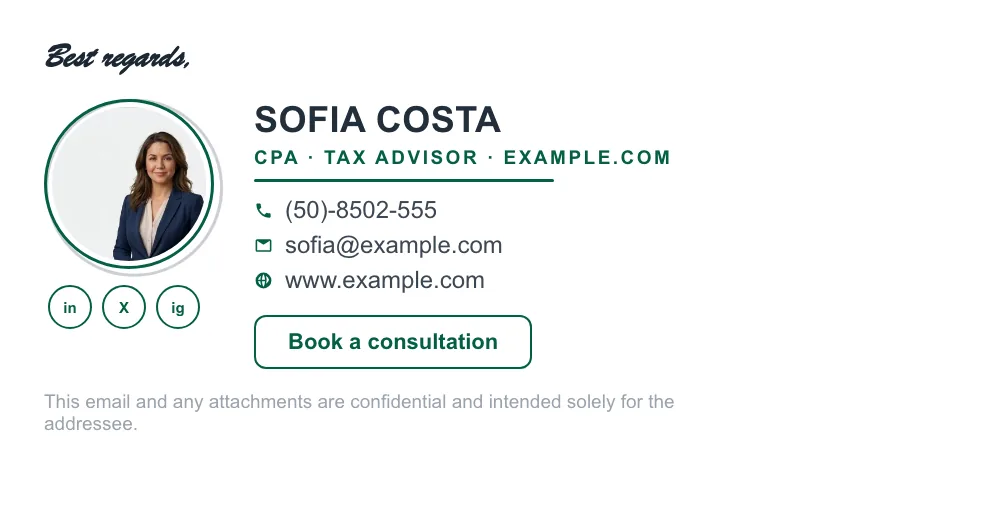
Real renders, not mockups — this is the output that reaches an inbox. Under each is why that layout suits this kind of work.


Written and maintained by the ProSignature team. Competitor pricing and feature claims on this site are verified against each vendor's live page on the day of writing — last verified 26 July 2026. No affiliate links. How we work.
Build a massage practice signature in minutes
Design it in minutes and install it in one click.
Create my signature — freeFrequently asked questions
What should a massage therapist's email signature include?
Name with your exact credential (LMT, RMT, LMBT) and the state or province it is held in, two or three modalities you actually practise, where you work, an online booking link, and a short scope note that massage complements rather than replaces medical care.
Do massage therapists need to show a licence number in email?
In many US states and Canadian provinces the title is licensed or registered and the number is expected in professional advertising. Requirements vary by jurisdiction — confirm with your licensing board or association.
What should a massage therapist avoid saying in a signature?
Anything implying diagnosis, treatment or cure, and any outcome or before-and-after claim. Describe modalities and what a session involves instead — it is both safer and more useful to the client.
What is the best call-to-action for a massage practice?
An online booking link. Enquiries frequently arrive outside working hours from someone in discomfort, and a booking link converts that moment where a phone number asks them to wait.