Home › Veterinarians
Email signatures for veterinarians & clinics
Pet parents read your emails with a worried heart. A warm clinic signature with clear hours, an appointment link and emergency info is genuinely useful care.
Why your email signature matters for veterinarians
Veterinary emails mix logistics with anxiety — results, follow-ups, boarding questions. A clinic signature with DVM credentials, hours, an appointment button and a clearly-marked emergency line answers half the questions before they're asked, and the consistent warm branding makes your clinic feel as caring in the inbox as in the exam room.
What to put in a veterinarian email signature
DVM credentials
Proper doctor titles for every vet in the practice.
Appointment link
Bookings straight from any email thread.
Emergency-hours note
The line every worried pet parent scans for.
Clinic branding
Logo and colors pulled from your website automatically.
Build yours in minutes
- Open the generator and enter your work email — your logo, colors and social links are imported from your website automatically.
- Pick a template and fill in your name, title and the details that matter for your role.
- Add a call-to-action button — the one action you most want recipients to take.
- Install it into Gmail or Outlook in one click, or roll it out to your whole team.
What belongs in this signature, line by line
The fields below are the ones this profession is actually judged on — by clients, by referral sources and in some cases by a regulator.
Name + credential
DVM, VMD, BVSc, plus any board specialty (ACVIM, ACVS). Referring vets read these first.
Practice name and location
Veterinary care is local and often urgent; the suburb matters.
Practice phone and after-hours instructions
The single most important line: where to go at 2am. Most emergencies start with a client who does not know.
Species or discipline focus
Small animal, equine, exotics, farm — a genuine routing filter.
Booking link for routine appointments
Deflects the calls that do not need a phone conversation.
Referral contact, if you accept referrals
Separate from the client-facing line.
The after-hours line is the one that matters
Veterinary practices receive a steady volume of email from worried owners, and a meaningful share of it concerns animals that need to be seen now rather than answered later. That makes the emergency instruction the highest-value element in a vet's signature — not a marketing line, but a plain statement of what to do outside opening hours and which emergency hospital to go to. Practices that omit it discover the cost when someone emails at midnight and waits for a reply. The corollary is a brief note setting expectations: that email is not monitored continuously and is not appropriate for urgent clinical concerns. Beyond that, keep clinical content out of the signature entirely — no treatment claims, no advice that could be read as applying to an animal the sender has described.
Two audiences again: owners and referring vets
Like specialist dentists, veterinary practices serve pet owners and referring colleagues with one block. Owners need warmth, location, booking and the emergency line. Referring vets need credentials, board specialty, species focus and a direct professional contact — and a consumer-facing promotional banner reads oddly on a referral letter. Specialty and emergency practices, whose business depends heavily on referrals, generally lead with credentials and keep the client-facing elements secondary. Multi-vet practices should deploy one design with each clinician's own credentials rather than letting each compose their own — see team deployment.
Mistakes that show up most in this field
No after-hours or emergency instruction
The most consequential omission available to a veterinary practice.
Clinical advice in an auto-appended block
Nothing in a signature should read as applying to a specific animal.
A personal mobile instead of the practice line
Creates unmanageable after-hours clinical exposure.
A promotional banner on referral correspondence
Colleagues are not the audience for a dental-month special.
A signature template you can copy, line by line
The structure below is what most small-animal practices converge on. Adapt the wording; keep the order, because it matches the order a worried owner reads in.
Small Animal Medicine & Surgery
Riverside Veterinary Clinic
12 Mill Road, Riverside · (555) 010-4477
Mon-Fri 8-6, Sat 9-1 · Book an appointment
Emergency after hours: Riverside Animal Emergency, (555) 010-9000
This email is not monitored continuously and is not for urgent clinical concerns.
Six lines plus two smaller ones. Note what is not there: no practice mission statement, no social icons row, no inspirational quote, and nothing that could identify a patient.
Specialists and referral practices need a second version
If you take referrals, one signature cannot serve both audiences well. A referring general practitioner is scanning for your board certification, your species and discipline, and a direct professional line that does not route through the client reception queue. An owner is scanning for location, hours and how to book. Practices that handle this well keep two variants and switch by recipient:
Client-facing
Warm, practical: name and DVM, practice, address, hours, booking link, and the after-hours emergency line in a colour that stands out.
Referral-facing
Credential-led: name with DVM plus board certification (ACVIM, ACVS, ACVO and so on), species and discipline focus, a direct line or referral coordinator, and how to send imaging or records.
What both must carry
The note that email is not monitored continuously and is not for urgent clinical concerns. It protects the practice and sets expectations before a crisis rather than during one.
What neither should carry
Any patient-identifying detail. Chart numbers, appointment references and case notes must never live in an auto-appended template.
Multi-vet practices: get this right once
The moment a practice has more than two clinicians, signatures drift — different fonts, different logo sizes, one vet with the emergency line and three without it. That last one is the reason this matters clinically rather than cosmetically: the after-hours instruction is the most important line in the block, and it should not depend on whether an individual clinician remembered to add it.
The fix is to design one signature with the fixed parts locked — practice name, address, hours, emergency routing, the email-is-not-monitored note, logo and colours — and only the per-clinician fields variable: name, credentials, board certification, discipline. Each vet connects their own mailbox once; nobody retypes a regulated or safety-critical line. When the emergency provider changes, it changes once for everyone. That mechanism is described in team deployment.
Seasonal notices, used sparingly
Veterinary practices have a handful of genuinely useful seasonal messages, and they perform well precisely because they are information rather than advertising: parasite-prevention season, holiday opening hours, a heat-warning notice, vaccination clinics, or a change of emergency provider. Put those in a banner strip that sits below the signature and is swapped centrally — never rewritten into the signature itself.
Two cautions specific to this field. Keep promotional banners off referral correspondence: a dental-month offer under a letter to a colleague reads poorly. And remove a banner the day it expires — an out-of-date holiday-hours notice is worse than none, because owners rely on these emails for operational facts. Build them free in the AI Banner Maker.
Three layouts that work for this profession
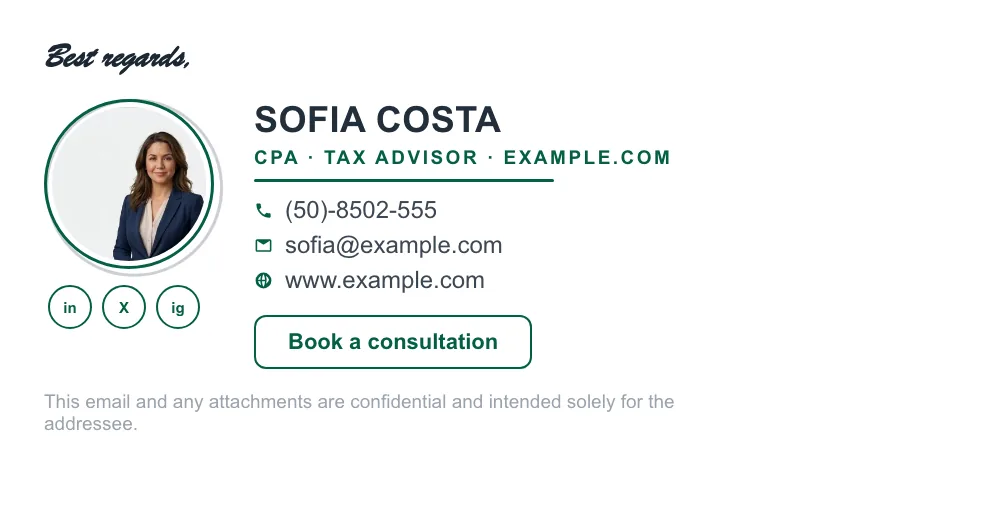
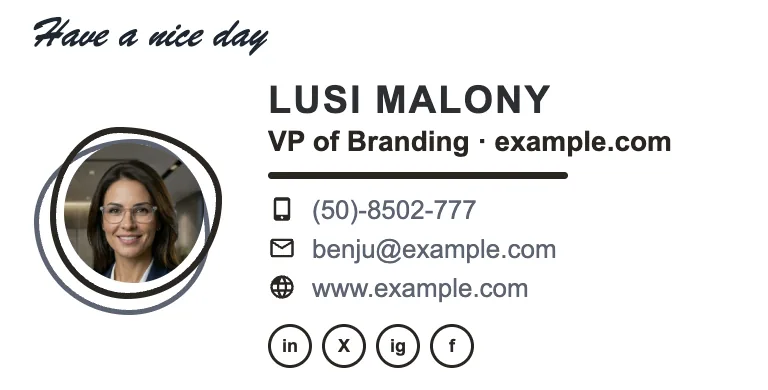
Real renders, not mockups — this is the output that reaches an inbox. Under each is why that layout suits this kind of work.

Written and maintained by the ProSignature team. Competitor pricing and feature claims on this site are verified against each vendor's live page on the day of writing — last verified 26 July 2026. No affiliate links. How we work.
Care that shows before the visit
Design it in minutes and install it in one click.
Create my signature — freeFrequently asked questions
Can techs and front desk match the vets?
Yes — one clinic design for everyone who emails clients, with role-appropriate details.
Seasonal reminders in the signature?
Use the banner slot — vaccination drives, dental month, boarding deadlines — swapped clinic-wide in minutes.
Does it work with our clinic Gmail?
Yes — Google Workspace installs one-click; Outlook via copy-paste.
What should a veterinarian's email signature include?
Name with credential (DVM, VMD, BVSc) and any board specialty, practice name and location, practice phone with clear after-hours emergency instructions, species or discipline focus, and a booking link for routine appointments.
Why do vets need emergency instructions in their signature?
Because worried owners email about animals that need to be seen immediately. A plain line stating that email is not monitored continuously and naming where to go after hours prevents dangerous waiting.
Should a veterinary signature differ for referring vets?
Ideally the block leads with credentials and species focus for professional correspondence, since referral relationships drive specialty practices, with client-facing elements kept secondary.
What should a veterinarian's email signature template look like?
Name with DVM and any board certification, discipline or species focus, practice name and address, opening hours, a booking link, and — most importantly — a clearly marked after-hours emergency contact, plus a short note that email is not monitored continuously and is not for urgent clinical concerns. Around six lines.
Should a veterinary practice use different signatures for owners and referring vets?
Ideally yes. Referring clinicians scan for board certification, discipline and a direct professional line; owners need location, hours and booking. Both versions should carry the not-monitored note, and neither should ever contain patient-identifying detail.
How do multi-vet practices keep signatures consistent?
Lock the fixed parts — practice details, hours, emergency routing, the not-monitored note, logo and colours — and leave only name, credentials and discipline variable per clinician. It matters clinically as well as visually: the after-hours line should not depend on an individual remembering to add it.
Can a veterinary practice put promotions in an email signature?
Use a swappable banner below the signature for genuinely useful seasonal information — parasite season, holiday hours, a changed emergency provider. Keep promotional banners off referral correspondence, and remove them the day they expire, since owners rely on these emails for operational facts.