Home › HR professionals
Email signatures for HR professionals & recruiters-in-house
Candidates screenshot your emails; employees forward them. An on-brand HR signature with a careers link turns routine mail into an employer-branding channel.

Why your email signature matters for HR professionals
HR sits at the company's most-read inbox: offers, onboarding, policy notes. A branded signature with a careers-page CTA quietly advertises open roles in every thread — and a booking link ends the scheduling ping-pong with candidates. Deploy the same design company-wide and the whole org looks as organized as you are.
What to put in a HR professional email signature
Company brand, exact
Logo and colors pulled from your site — matches the offer letter.
Careers-page CTA
'We're hiring' in every email — free, always-on job marketing.
Booking link
Candidates self-schedule screens; no more timezone email chains.
Confidentiality line
For offers and ER matters, styled to whisper.
Build yours in minutes
- Open the generator and enter your work email — your logo, colors and social links are imported from your website automatically.
- Pick a template and fill in your name, title and the details that matter for your role.
- Add a call-to-action button — the one action you most want recipients to take.
- Install it into Gmail or Outlook in one click, or roll it out to your whole team.
What belongs in this signature, line by line
The fields below are the ones this profession is actually judged on — by clients, by referral sources and in some cases by a regulator.
Name + role and which part of HR you own
“Talent Acquisition”, “People Operations”, “Compensation & Benefits” — employees route questions faster when they know.
Company name and, for large organisations, the business unit
Employees in a 500-person company need to know which HR you are.
Direct line and stated hours
HR receives sensitive, urgent-feeling questions; bounded availability is kinder than silence.
A careers-page link on recruiting correspondence
The one CTA that belongs in HR email — and only on the recruiting side.
Confidentiality note
HR correspondence frequently involves personal and employment-sensitive information.
Employee-resources or HRIS link, for internal-facing roles
Deflects the most repetitive questions before they are asked.
HR email is two jobs with opposite tones
HR signatures fail when one block tries to serve both of HR's audiences. Candidate-facing email is marketing: it should carry the employer brand, a warm photo, a careers-page link and often a “we're hiring” banner, because the recipient is deciding whether your company is worth their time. Employee-facing email is the opposite: it may concern grievances, medical leave, performance or termination, and a cheerful recruitment banner under a message about someone's health insurance is tone-deaf at best. Organisations that handle this well either keep the internal signature deliberately plain — name, role, contact, confidentiality line — or run two variants. If you do only one, err toward the restrained version; the recruiting audience forgives plainness far more readily than an employee in a difficult moment forgives a promotional banner. The recruiting-specific playbook is in the recruiter guide.
Consistency is an employer-brand asset
Candidates form impressions from surprisingly small signals, and an HR team whose members all email with visibly different signatures suggests an organisation with weak internal standards — precisely the inference you do not want during hiring. Because HR is also usually the team that owns employer brand, it is well placed to model what good looks like: one locked design, correct titles, consistent logo treatment, deployed centrally and updated in one place when the brand changes. That same mechanism then extends naturally to the rest of the company, which is how most organisations end up standardising signatures at all — see team deployment.
Mistakes that show up most in this field
A recruiting banner on sensitive internal email
The single worst tonal error available to an HR team.
No stated hours
Employees with urgent-feeling questions need to know when to expect a reply.
Ambiguous role in a large organisation
“HR” alone sends every question to the wrong person.
Inconsistent signatures inside the team that owns employer brand
Candidates notice, and it is the team least able to justify it.
Three layouts that work for this profession
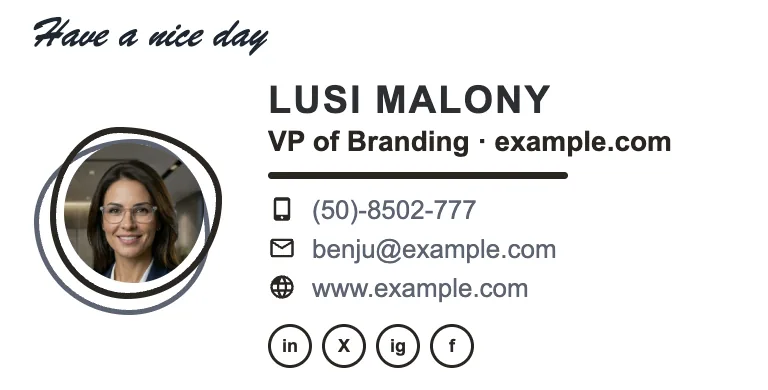
Real renders, not mockups — this is the output that reaches an inbox. Under each is why that layout suits this kind of work.

Written and maintained by the ProSignature team. Competitor pricing and feature claims on this site are verified against each vendor's live page on the day of writing — last verified 26 July 2026. No affiliate links. How we work.
Every email is employer branding
Design it in minutes and install it in one click.
Create my signature — freeFrequently asked questions
Should HR signatures differ from the rest of the company?
Same design, one extra CTA: the careers link. Teams deployment handles per-department variants.
Can I A/B the CTA?
Swap the button text/link anytime and reinstall in one click — try 'We're hiring' vs a specific role.
Offer emails too?
Yes — a consistent, branded signature on offer mail measurably reads as more legitimate to candidates.
What should an HR email signature include?
Name, the specific HR function you own, company and business unit, direct line with stated hours, a confidentiality note, and — on recruiting correspondence only — a careers-page link.
Should HR use the same signature for candidates and employees?
Ideally not. Candidate-facing email benefits from employer branding and a careers link; employee-facing email about leave, grievances or performance should be plain. If you keep one, choose the restrained version.
Can HR put a 'we're hiring' banner in email signatures?
On recruiting and external correspondence, yes — it is free reach. On internal email about sensitive matters, no.