Home › Lawyers & attorneys
Email signatures for lawyers & law firms
For attorneys, a signature signals credibility and covers the essentials — firm branding, your admissions, and the confidentiality notice your emails need.

Why your email signature matters for lawyers
Clients and opposing counsel form an impression from the details. A consistent signature with your firm's branding, your title and bar admissions, and a proper confidentiality disclaimer looks professional and keeps your communications buttoned-up.
What to put in a lawyer email signature
Firm name & logo
Consistent firm branding across every attorney's email.
Title & bar admissions
Partner, Associate, Of Counsel — plus the jurisdictions you're admitted in.
Direct line & office address
Physical address and direct dial, as clients expect from a firm.
Confidentiality disclaimer
A privileged-and-confidential legal disclaimer at the foot of every email.
Practice or booking link
A button to your practice page or a consultation-booking calendar.
Consistent firm-wide format
Roll one locked template out to the whole firm so every signature matches.
Build yours in minutes
- Open the generator and enter your work email — your logo, colors and social links are imported from your website automatically.
- Pick a template and fill in your name, title and the details that matter for your role.
- Add a call-to-action button — the one action you most want recipients to take.
- Install it into Gmail or Outlook in one click, or roll it out to your whole team.
What belongs in this signature, line by line
The fields below are the ones this profession is actually judged on — by clients, by referral sources and in some cases by a regulator.
Name + admissions
Which bars you are admitted to, and any “not admitted in X” note if you practise across state lines.
Firm name, exactly as registered
Including LLP/PC/PLLC — the entity form is part of the firm's legal identity.
Practice area
“Commercial litigation” routes enquiries far better than “Attorney”.
Direct line and, if relevant, a secure-contact note
Privileged matters warrant saying how to reach you securely.
Confidentiality / privilege notice
The classic legal disclaimer — kept short.
No-attorney-client-relationship line where appropriate
Particularly if you receive unsolicited enquiries by email.
The disclaimer, and why length is the enemy
Legal signatures carry more mandated text than any other profession's: privilege and confidentiality notices, sometimes a statement that emailing does not create an attorney-client relationship, sometimes tax-advice or jurisdictional caveats. The failure mode is not omitting them — it is letting them balloon until the disclaimer is three times the size of the contact details and nobody reads any of it, including the part that protects you. The fix is typographic rather than legal: keep the disclaimer at a smaller size in a muted grey, below a divider, in two or three sentences of plain English. Requirements differ by jurisdiction and firm policy — confirm yours; our general overview is in legal requirements and the disclaimer generator assembles the standard clauses.
What a law-firm signature should not try to do
Most signature advice pushes marketing devices — banners, booking buttons, promotional CTAs. Law is the profession where that advice mostly does not transfer. Opposing counsel, courts and clients in active matters all receive the same signature, and a “Book a free consult!” button under a filing reads badly. If you do want a call-to-action, keep it to one restrained link — a consultation page or the firm profile. Where firms genuinely benefit is consistency: one locked design across every fee-earner, with correct entity naming and disclaimers, deployed centrally rather than retyped. See team deployment.
Mistakes that show up most in this field
A disclaimer longer than the email
Two or three sentences, smaller type, muted colour, below a divider.
Omitting the entity form
“Smith & Co” instead of “Smith & Co LLP” misstates the firm's legal identity.
Marketing banners on litigation correspondence
Right instinct, wrong profession — or at least wrong recipient list.
Inconsistent formats across fee-earners
Clients read it as a firm that does not control its own details.
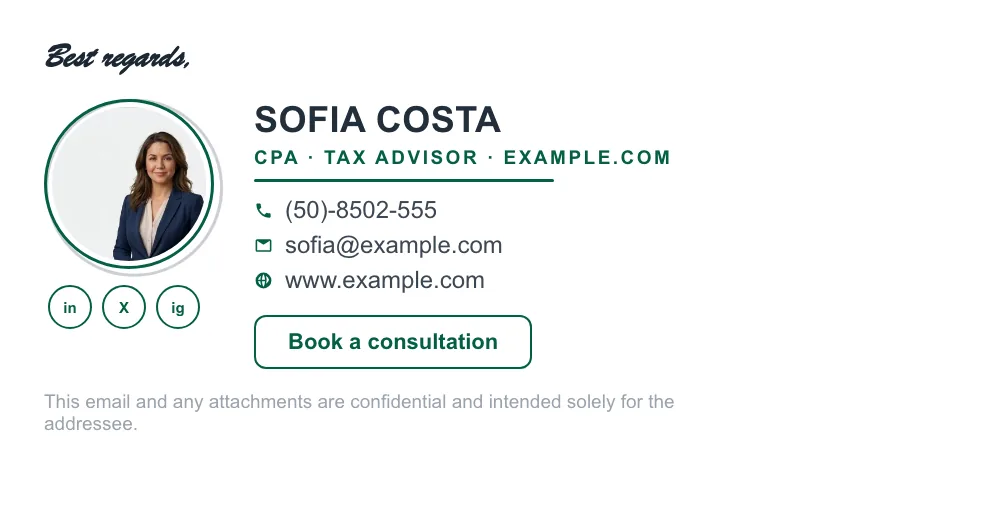
Three layouts that work for this profession
Real renders, not mockups — this is the output that reaches an inbox. Under each is why that layout suits this kind of work.

Written and maintained by the ProSignature team. Competitor pricing and feature claims on this site are verified against each vendor's live page on the day of writing — last verified 26 July 2026. No affiliate links. How we work.
Signal credibility on every email
Design it in minutes and install it in one click.
Create my signature — freeFrequently asked questions
What should a lawyer's email signature include?
Your name, title (e.g. Partner or Associate), firm name and logo, the jurisdictions where you're admitted to the bar, a direct phone number and office address, and a confidentiality disclaimer.
Can I add a legal confidentiality disclaimer?
Yes. ProSignature includes an editable legal disclaimer field, so the privileged-and-confidential notice appears at the bottom of every signature.
Can our whole firm use the same signature format?
Yes. Design one master signature, lock the branding, and deploy it across every attorney and staff member so the firm looks consistent.
How long should a legal email disclaimer be?
Two or three plain-English sentences, set smaller and in a muted colour below a divider. Long disclaimers are ignored, which defeats their purpose.
Should a law firm signature include a photo?
Client-development and transactional practices often benefit; litigation correspondence usually reads better plain. Firms that want both typically standardise on one and allow a variant.